
Detroit — History & Overview
General Overview
Detroit is the largest city in Michigan and the seat of Wayne County. Positioned directly on the Detroit River — acting as a major international gateway bordering Windsor, Ontario — it anchors the nation's 14th-largest metropolitan area with over 4.3 million regional residents.
Affectionately known as "The Motor City" or "Motown," Detroit holds a legendary status in global industrial and cultural history. Its population is approximately 650,000, reflecting an exciting new chapter: after decades of mid-century population decline, the city has officially recorded consecutive years of steady population growth, fueled by aggressive neighborhood revitalization and housing investments.

Economy
While still deeply rooted in automotive engineering, manufacturing, and supply chain logistics (headquarters to General Motors and major operations for Ford and Stellantis), Detroit's modern economy is highly diversified. It is a major hub for healthcare, financial services (Rocket Companies), technology, defense, and international trade.
Culture & Innovation
Detroit is the first and only city in the United States to receive the UNESCO "City of Design" designation. It boasts a world-class theater district, the Detroit Institute of Arts (DIA), and an unparalleled musical legacy spanning jazz, techno, and the legendary Motown sound.
Demographics
Detroit is one of the most prominently Black-majority major cities in the United States. According to the 2020 U.S. Census and American Community Survey estimates:
- Population: approximately 639,000 (2020 census), with recent consecutive years of growth
- Racial composition: ~78% Black or African American, ~11% White (non-Hispanic), ~7% Hispanic or Latino, ~1% Asian, ~3% multiracial or other
- Median household income: approximately $35,000
- Median age: approximately 35
- Poverty rate: approximately 30%, though targeted investment and economic development are driving steady improvement
The city's demographic makeup is deeply rooted in the Great Migration of the early-to-mid 20th century, which brought hundreds of thousands of Black Americans from the rural South to Detroit's booming factories, fundamentally shaping the city's culture, politics, and identity.
History
The Strategic Frontier (1701–1815)
Long before European contact, the Detroit River straits were an essential trade and cultural hub for Indigenous peoples, particularly the Anishinaabe (including the Ojibwe, Ottawa, and Potawatomi, known as the Council of Three Fires).
On July 24, 1701, French explorer Antoine de la Mothe Cadillac, along with roughly 100 Frenchmen and 100 Algonquian allies, established Fort Pontchartrain du Détroit ("Fort Pontchartrain of the Strait"). The outpost was designed to control the Great Lakes fur trade and prevent British expansion.
Control of the settlement shifted frequently over the next century:
- 1760: The British seized the fort during the French and Indian War. In 1763, it withstood a historic, months-long siege led by Chief Pontiac.
- 1796: Under the terms of the Jay Treaty, Detroit finally came under American sovereignty.
- 1805: A catastrophic fire completely leveled the town. Territorial Judge Augustus Woodward redesigned the city from the ashes, using an ambitious, geometric spokes-and-hub street plan inspired by Washington, D.C.
- 1815: Detroit was officially incorporated as a city, briefly serving as Michigan's original state capital until it moved to Lansing in 1847.

Industrial Rise and the "Arsenal of Democracy" (1860–1945)
During the late 19th century, Detroit's access to Great Lakes shipping lanes and heavy rail lines turned it into a major manufacturing hub for stoves, railcars, and pharmaceuticals.
This infrastructure set the stage for a global revolution. In 1903, Henry Ford founded the Ford Motor Company, followed quickly by the founding of General Motors and Chrysler. With Ford's perfection of the moving assembly line in 1913, Detroit became the undisputed Automotive Capital of the World.
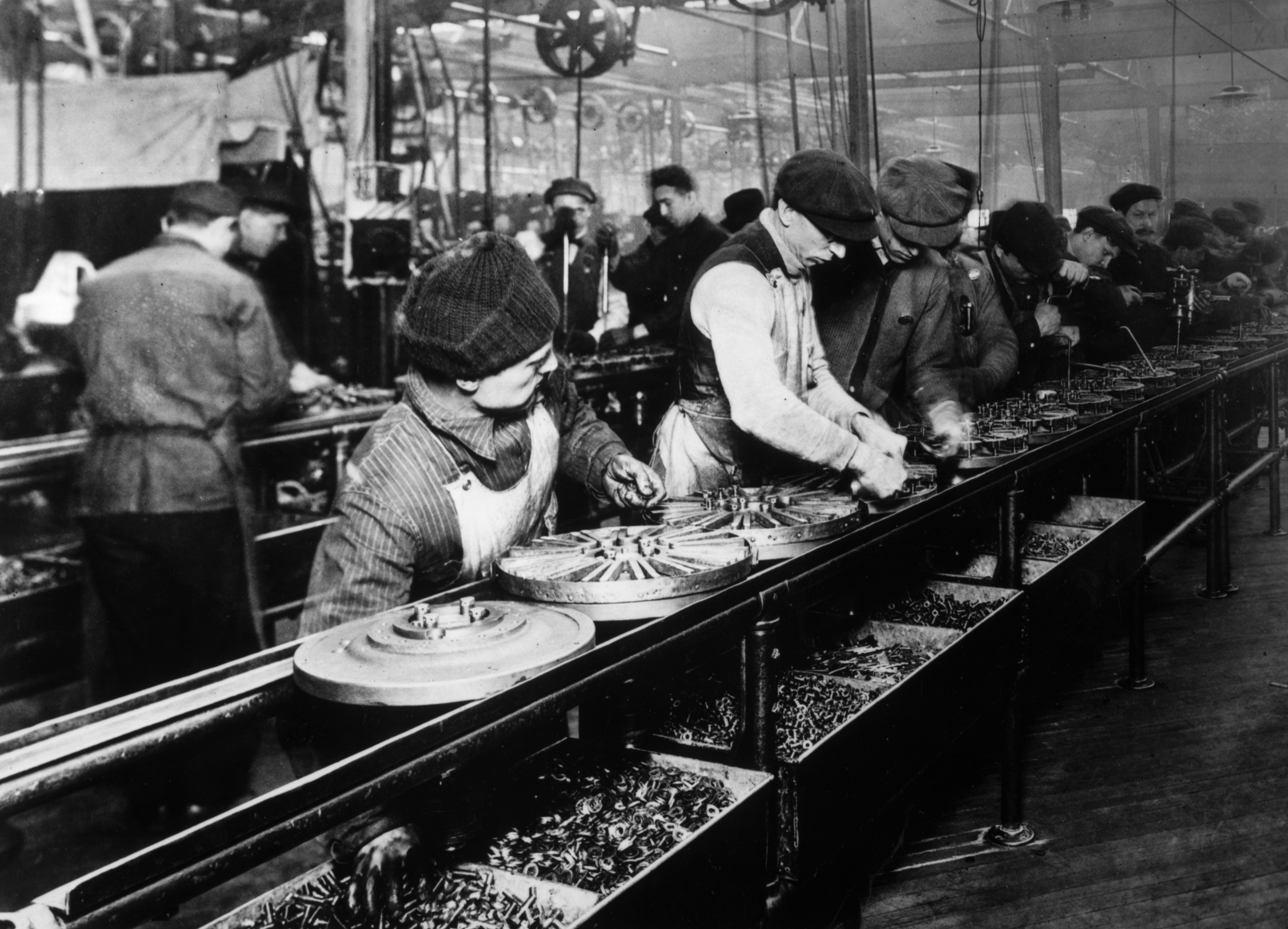
The city's population exploded, skyrocketing from roughly 285,000 in 1900 to nearly 1.6 million by 1930. This growth was heavily propelled by the Great Migration, which brought hundreds of thousands of Black Americans from the rural South, alongside waves of European immigrants. During World War II, Detroit's factories pivoted entirely to military production, building thousands of tanks, B-24 bombers, and engines, earning the city the moniker "The Arsenal of Democracy."
Post-War Friction, Cultural Triumph, and Rebirth (1950s–Present)
Detroit's population peaked in the early 1950s at over 1.8 million residents. However, the subsequent decades brought complex structural changes. Auto manufacturers began decentralizing operations, building massive automated plants in outer suburbs and other states. Combined with federal highway construction and systemic redlining, this sparked massive suburban flight.
Despite economic headwinds, Detroit's cultural power peaked globally. In 1959, Berry Gordy Jr. founded Motown Records, creating a crossover pop-soul sound that reshaped American music. Simultaneously, the city became a crucible for the Civil Rights movement, hosting the 1963 Walk to Freedom led by Dr. Martin Luther King Jr.
The city faced severe challenges in the late 20th century, culminating in a historic Chapter 9 bankruptcy filing in 2013. However, Detroit used the restructuring as a launching pad for a remarkable turnaround. Through an innovative "Grand Bargain" that protected municipal pensions and preserved the masterworks of the Detroit Institute of Arts, the city successfully exited bankruptcy in under a year.
Today, Detroit is defined by its resilience. A downtown and midtown commercial boom, widespread neighborhood stabilization projects, and a renewed tech sector have transformed the city into a national model for urban adaptation, proving that the Motor City is built to last.